
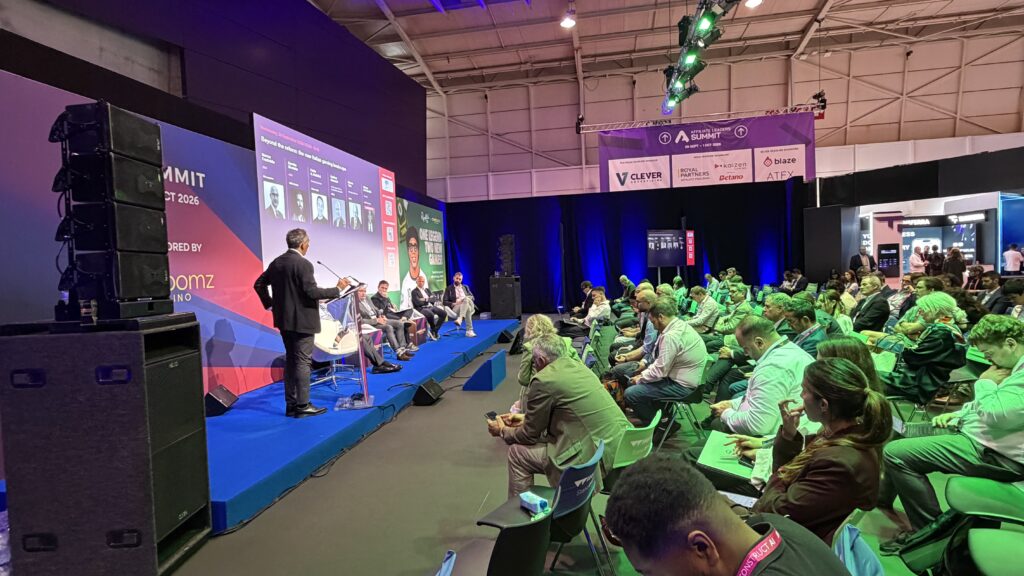

From the stage in Lisbon, a portrait emerges of a profoundly changed market: online gaming is growing and facing a new regulatory season, the player is now omnichannel, and concentration is increasing. However, the reorganization of the retail sector remains the great missing piece. A dialogue featuring De Fabritiis, Tiso, Diodato, Castaldo, Bufalini, and Mancini in the panel sponsored by Italian Gaming News.
LISBON – The market has already changed. So has the consumer. Technology even faster. What has remained behind, at least in a decisive part of the Italian gaming system, is regulation.
This is perhaps the most effective summary of the panel “Beyond the Reform: The New Italian Gaming Landscape,” held at the SBC Summit 2026 in Lisbon and organized by ItalianGamingNews.it. A discussion that, starting from the reorganization, ended up telling a broader story: the structural transformation of Italian gaming and the growing distance between the evolution of the market and that of its rules.
Moderated by Mauro De Fabritiis, founder of Mdf Partners, the debate brought together Marco Tiso, managing director of Sisal, Davide Diodato, CEO of Hbg Online (Novomatic), Marco Castaldo, CEO of Microgame, Fabio A. Bufalini, country manager of Stake Italia, and Quirino Mancini, partner and director of Wh Partners Italy.
Ten years that reshaped the market
The scale of the transformation was first captured by the figures presented by De Fabritiis. Between 2016 and 2025, the combined share of gaming machines and retail bingo fell from 58% to 38% of the market, while online gaming rose from 5% to 26%. Over the same period, total GGR increased by 1.4%, but that apparently stable headline figure conceals sharply diverging trends: online grew by 20.9%, while the overall retail segment declined by 1.3%.
The competitive structure has changed as well. The top five groups accounted for 68% of GGR in 2016 and 84% in 2025, with concentration even higher in the retail segment.
This is therefore about much more than volumes migrating from physical locations to digital channels. The figures point to consolidation, new consumer habits, technological acceleration and, above all, growing convergence between channels. That is where the Italian paradox becomes most apparent: while the market is becoming omnichannel, regulation still largely treats its different components as separate worlds.
Tiso: the consumer is already omnichannel
Marco Tiso brought the discussion directly to the player experience. Consumer behaviour, he argued, has once again moved ahead of regulation: customers now move naturally between online and physical channels, while the regulatory framework has yet to fully accommodate that evolution.
The contrast between the two environments is striking. Online gaming has undergone repeated regulatory updates and is entering a new phase marked by higher standards of quality, protection and customer experience. Retail, by contrast, still has to operate within a framework largely designed around twenty years ago.
The result is an inconsistent experience: products, payout structures, promotions and loyalty programmes can differ according to the channel through which the same consumer accesses the same regulated market.
For Tiso, the future sustainability of retail depends on two key issues: finally clarifying the relationship between central and local authorities, and building a regulatory model centred on the consumer. He also offered an intriguing perspective on the future of omnichannel gaming. After years in which the dominant flow was from shops towards digital, online could eventually become a driver bringing customers back into physical venues in search of the social and collective experience that digital channels cannot fully replicate.
Diodato: two speeds that are increasingly difficult to integrate
The consequences of the unfinished land-based reform become even more tangible in Davide Diodato’s analysis. On one side is a digital platform that must innovate continuously; on the other, a physical network that has been constrained for years by uncertainty. Integrating the two, including in ways that generate economies of scale, inevitably becomes more difficult.
And the problem does not affect major concessionaires alone. Uncertainty travels down the entire supply chain to smaller retail outlets, which must decide whether to invest, hire staff or innovate without sufficient visibility over the rules that will govern their future.
Diodato also highlighted another shift likely to reshape the market: the relationship between online gaming and the physical territory. Over the past fifteen years, affiliation through retail networks has been one of the pillars of the Italian model. In the years ahead, digital tools are likely to play a substantially greater role in customer acquisition and engagement.
Italy as a laboratory for online regulation
If the problem in retail is the absence of a completed reform, the online picture is almost the mirror image.
Marco Castaldo went so far as to describe the situation as “hyper-regulation”. Italy is now entering what is effectively the third major regulatory era for online gaming, with significantly higher licence costs, new restrictions, additional platform requirements and greater technical complexity in certification and integration.
From this perspective, the Microgame CEO argued that Italy can almost be viewed as a regulatory laboratory: developments in the Italian market today may provide an indication of where other regulated jurisdictions will move in the years ahead.
The cost of this evolution, however, may be a further acceleration in market consolidation. Castaldo noted that concentration has already increased and expects leading groups to become stronger still, thanks to their ability to sustain the technological, regulatory and brand investments demanded by the new environment. The challenge will be much tougher for smaller operators unless they can build genuinely distinctive positions.
Bufalini: clear rules, but competitiveness matters
Fabio Bufalini focused on precisely this delicate balance between regulation and the ability to compete.
From the perspective of an international operator that has entered the Italian market, the new framework provides clarity and transparency while raising the level of consumer protection. But market access requires investment, certification, procedures and compliance standards that inevitably narrow the field of companies able to compete effectively.
The issue becomes even more sensitive when the regulated market is forced to compete with unauthorised operators. Bufalini drew particular attention to restrictions on promotion and customer acquisition: licensed operators must work within tight constraints, while illegal businesses can exploit channels such as social media with far greater freedom.
This suggests a possible change of perspective: obligations relating to player protection, self-exclusion and controls should not be viewed solely as compliance costs, but also as distinctive features of the regulated offer. Together with institutions, the industry could build a communication strategy capable of explaining why playing within the regulated system means choosing operators subject to supervision and specific duties of care.
Mancini: the real obstacle is political
Yet one issue remained the elephant in the room throughout the discussion: the reform of land-based gaming.
Quirino Mancini shifted the debate from the technical to the political level. The reorganisation of the physical network, he noted, has been under discussion for around a decade. During that period, governments, regions and municipalities have held repeated negotiations, and many of the fundamental elements of a future framework have already been extensively debated.
The underlying principle would be to give the State responsibility for the overall framework – including the size and density of the network, opening hours and parameters governing distances from sensitive locations – while leaving regional and municipal authorities to implement those rules locally.
The challenge, therefore, is no longer simply to identify a technically workable solution. It is to create the political conditions to adopt it. Mancini expressed serious doubts that such a sensitive issue can be definitively resolved as Italy moves closer to another electoral cycle.
A reform beyond the reform
This is where the title chosen for the Lisbon discussion takes on its most interesting meaning.
Going “beyond the reform” means recognising that Italian gaming can no longer be understood simply through the traditional divide between online and retail. Consumers have already moved beyond it. Operators are trying to do the same. Technology, payments, platforms and customer journeys are progressively erasing the boundaries between channels.
Regulation, however, continues to move at different speeds.
On one side is an online market that, from 13 November, will concretely enter its new licensing era, with higher standards but also greater costs and barriers to entry. On the other is a land-based network still waiting for a framework capable of restoring investment certainty and territorial consistency. In between are operators growing larger, smaller businesses searching for new economies of scale, retail outlets waiting to understand their future, and consumers who no longer experience the market according to the categories through which it continues to be regulated.
Despite the different perspectives represented on stage, the message from Lisbon was therefore remarkably clear: regulating individual channels is no longer enough. The ecosystem itself must be governed.
Because the real risk is not simply that a regulation becomes outdated. It is that, while the debate over how to change it continues, the market itself has already become something entirely different.