
At Gaming in Spain 2026, Mauro De Fabritiis compares the user experience of crypto casinos and licensed operators in Spain. From registration to payments, from the gaming offer to promotions, international platforms show significant advantages in terms of immediacy and flexibility. But when it comes to consumer protection, an equally clear gap emerges, raising questions about the future of regulation.
Madrid – The competition between regulated gambling and international platforms is no longer measured solely on product range, odds, or the appeal of promotions. Increasingly, it plays out on the overall user experience. And it is precisely on this ground that operators using cryptocurrencies appear to have gained a significant competitive advantage, leveraging leaner procedures, fast payments, and a particularly broad entertainment offer. However, this advantage comes with a downside: player protection levels that are notably lower than those guaranteed by the licensed market.
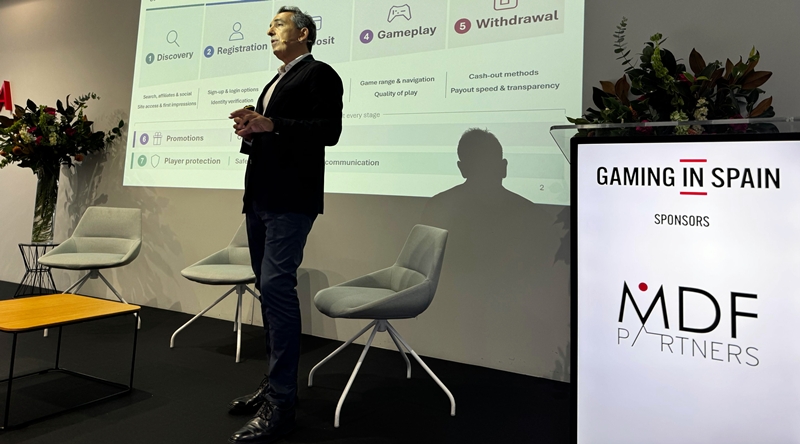
This is the picture that emerges from the analysis presented by Mauro De Fabritiis, Founder of MDF Partners, in Madrid at the Gaming in Spain 2026 event, during his talk titled: “Crypto vs regulated: Who is winning the player experience?“
The study examines seven fundamental dimensions of the gaming experience: customer acquisition, registration, deposits, gaming offer, withdrawals, promotions, and consumer protection. The comparison covers licensed operators in the Spanish market and several international crypto gambling platforms, highlighting the differences between two business models operating under profoundly different regulatory conditions.
Spanish regulation and the growing competitive gap
The starting point is Spain’s regulatory evolution, one of the European markets where the obligations imposed on licensed operators have become progressively more complex.
According to MDF Partners’ reconstruction, the sector has undergone six major regulatory interventions since 2020, four of which are scheduled between October 2026 and March 2027, including one measure still pending confirmation.
From the advertising restrictions introduced in 2020 to the new responsible gambling requirements of 2023, through to provisions on the ownership of payment instruments and cross-operator deposit limits, the Spanish system is progressively strengthening its control safeguards.
The goal is to increase consumer safety, but the research highlights a side effect: an inevitably more complex user experience compared to that offered by international platforms not licensed in Spain.
This is a particularly significant point, since ease of access and speed of transactions are increasingly important factors in digital competition, even when they stem from the absence of obligations that licensed operators are instead required to meet.
Registration: 18 fields versus two, the advantage of simplicity
One of the most significant findings concerns the account-opening process.
According to MDF Partners, a licensed operator in Spain typically requires around 18 fields to be filled in across three to six screens, including personal details, contact information, identification data, and identity verification procedures. The entire process can take at least five minutes.
The comparison with crypto casinos is stark: on the platforms analyzed, registration can be completed on a single screen, entering just two or three pieces of information, usually an email address and password. In some cases, users can sign in directly with a social account or digital wallet.
Identity verification is frequently postponed to a later stage, for example when a large withdrawal is requested.
The advantage in terms of potential conversion and reduced barriers to entry appears evident, although the research does not directly measure conversion rates for the two models.
At the same time, this very simplicity represents one of the main vulnerabilities of the crypto system, as it makes it harder to verify users’ identities in advance and to prevent access by individuals subject to self-exclusion measures.
Deposits and withdrawals: speed becomes a competitive factor
Another key element of the comparison concerns financial transactions.
Making a deposit with a licensed Spanish operator generally requires four or five steps, including selecting a payment method, entering the amount, and bank verification through systems such as 3D Secure.
Crypto casinos, on the other hand, allow users to pay directly with cryptocurrencies and wallets, through procedures that can be as simple as scanning a QR code or entering a digital address.
Greater speed does not necessarily translate into greater simplicity for all users: choosing a cryptocurrency, identifying the correct network, and transferring funds to a wallet requires specific skills. An error in the address or network can also result in the irreversible loss of the transferred funds.
However, it is above all on the withdrawal side that the sharpest difference emerges.
According to the analysis, some crypto platforms allow winnings to be received in the user’s wallet in around one minute, whereas at the Spanish operators examined, procedures can take up to three to five business days.
In some of the cases analyzed, withdrawals in the licensed market are also tied to the instrument used for the deposit, whereas crypto casinos allow transfers to different wallets.
Payment speed is therefore one of the most attractive elements of the international offer, although the times indicated reflect the characteristics of the services examined and are not a guarantee applicable to all operators.
Gaming offer: crypto casinos cover all the categories analyzed
The comparison also extends to the variety of entertainment available.
MDF Partners examined eleven types of casino games, comparing three licensed Spanish operators and three crypto platforms.
The result reveals a considerable difference: the three crypto operators analyzed offer all eleven categories considered, while the licensed ones offer six, four, and four respectively.
The gap mainly concerns certain types of live games, game shows, progressive jackpots, and certain innovative products such as Mines and Dice/Limbo.
By contrast, live roulette, traditional slots, and some crash-style games are present in both segments.
The research therefore captures a broader offer on the crypto platforms examined, without allowing these findings to be automatically extended to the entire Spanish or international market.
The finding nonetheless raises an industry-wide issue: the ability to innovate the product and expand entertainment options can become a decisive factor in consumer choice, especially when the regulated market encounters regulatory or technical limits in distributing certain types of games.
Marketing and acquisition: two almost opposite strategies
The difference between the two models also emerges in customer acquisition methods.
Licensed operators maintain an advantage in traditional digital marketing channels, such as search engines, affiliate marketing, and distribution through app stores. Crypto platforms, on the other hand, are particularly active in streaming and influencer marketing.
In MDF Partners’ assessment, on a scale of one to ten, crypto casinos score 10/10 in both streaming and influencer use, compared to 1/10 and 3/10 respectively for licensed operators.
The ratio is reversed in search engine marketing, where licensed operators reach 8/10 compared to 1/10 for crypto platforms.
These are qualitative scores assigned by the consulting firm based on the accessibility and use of the various channels, not market shares or advertising performance data.
The phenomenon nonetheless highlights a significant shift in acquisition strategies, with growing importance placed on digital communities, creators, and streaming platforms.
The composition of traffic also shows differences: according to MDF Partners’ analysis of Semrush data, 40% of crypto casino visitors use desktop devices, compared to 26% of licensed Spanish operators’ users.
A feature that the research links to the crypto audience’s greater familiarity with wallets, exchanges, and digital financial tools.
Promotions: 81% of crypto offers exceed 100 euros
The comparison of promotional policies is particularly significant.
The analysis, based on PromoSherlock data, shows that 81% of the crypto promotions considered have a value exceeding 100 euros, compared to just 22% of those offered by Spanish operators.
The difference also concerns the nature of the incentives. In the crypto market, 40% of the promotions analyzed involve cash rewards, compared to 20% in the regulated market.
International platforms therefore make greater use of direct monetary incentives and high-value promotions, while licensed operators offer a more varied mix of bonuses, free bets, and other formats.
This is a difference that makes the crypto offer particularly aggressive from a commercial standpoint, but it also raises questions about the sustainability of acquisition strategies and the possible effects of financial incentives on gambling behavior.
Responsible gambling: the gap is completely reversed
While crypto platforms show numerous advantages in terms of experience fluidity, the picture changes radically when the comparison shifts to consumer protection.
According to MDF Partners, the crypto casinos examined guarantee at most five of the thirteen protection measures considered under the Spanish system, while licensed operators are required to apply all of them.
The differences mainly concern self-exclusion mechanisms, cross-operator deposit limits, session monitoring, reconnection alerts, and tools for tracking gaming activity.
The most significant issue lies in the actual enforcement of exclusion measures.
In Spain, the national RGIAJ registry makes it possible to prevent a self-excluded individual from opening new accounts with licensed operators, thanks to prior identification.
In crypto casinos, however, a user who has requested self-exclusion can potentially circumvent the block by creating a new account with a different email address and another wallet.
The ease of registration, which represents a competitive advantage during the acquisition phase, thus becomes a risk factor when assessed from the standpoint of preventing problem gambling.
The “provably fair” paradox: technological transparency does not mean protection
One of the most interesting aspects of the study concerns the concept of provably fair, frequently used by crypto casinos as a distinguishing feature of their offer.
This is a cryptographic system that allows players to mathematically verify that the outcome of a given game has not been altered after the bet was placed.
The technology therefore introduces a form of direct verifiability of the outcome, particularly relevant for certain games developed in-house by the platforms.
However, MDF Partners points out, provably fair is not equivalent to the oversight exercised by a regulatory authority.
Cryptographic verification concerns the correctness of the mechanism used to generate an outcome, but it does not necessarily certify the overall reliability of the operator, the solvency of the platform, the regularity of payments, or the effectiveness of protection tools.
The Spanish licensing system, by contrast, includes controls extending to different game categories, operator obligations, and payment procedures.
In other words, technological transparency can represent an important innovation, but it does not replace institutional and legal guarantees.
The real problem is also the perception of safety
It is precisely on this point that the analysis offers perhaps its most interesting reflection.
Licensed operators are required to inform consumers of the risks of gambling, through messages warning of the possibility of losing money and developing problem gambling behaviors.
Crypto platforms, on the other hand, tend to build their communication around positive concepts such as security, transparency, instant payments, and the absence of checks.
This creates a communicative paradox: the system that offers greater institutional guarantees is also the one that must place greater emphasis on risk, while less controlled platforms can present themselves through reassuring messages focused on the benefits of the experience.
The gap between actual safety and perceived safety thus becomes a further dimension of competition.
And it is precisely here that MDF Partners raises one of the presentation’s concluding questions: is the industry sending players the right message?
Who is really winning? The challenge between competitiveness and protection
The research does not identify an absolute winner, but it highlights a contradiction set to take on growing importance in the European regulatory debate.
On one hand, crypto platforms demonstrate that it is possible to build digital experiences characterized by immediate accessibility, breadth of offer, payment flexibility, and speed of operations.
On the other, the regulated market offers a system of safeguards that includes identity checks, product controls, prevention tools, and avenues of recourse in the event of disputes.
The problem is that these two sets of characteristics are not necessarily perceived by consumers as having the same value.
The speed of a withdrawal is immediately verifiable. The simplicity of registration is evident from the very first access. The variety of games can be directly experienced.
The guarantees offered by regulation, on the other hand, often only become tangible when a problem actually occurs.
The question, then, is not simply whether crypto casinos or licensed operators will win, but how to make the regulated market competitive without weakening the protections that constitute its primary reason for existing.
For regulators, this means questioning the proportionality of obligations and the possibilities for simplifying processes. For operators, it means investing in technological innovation and experience quality without viewing compliance solely as a constraint.
For both, above all, it means confronting a reality that the comparison presented in Madrid makes evident: in a digital market, player protection cannot be separated from the quality of the experience offered.
And the ability to reconcile these two dimensions could become one of the main competitive factors in European gaming in the years ahead.