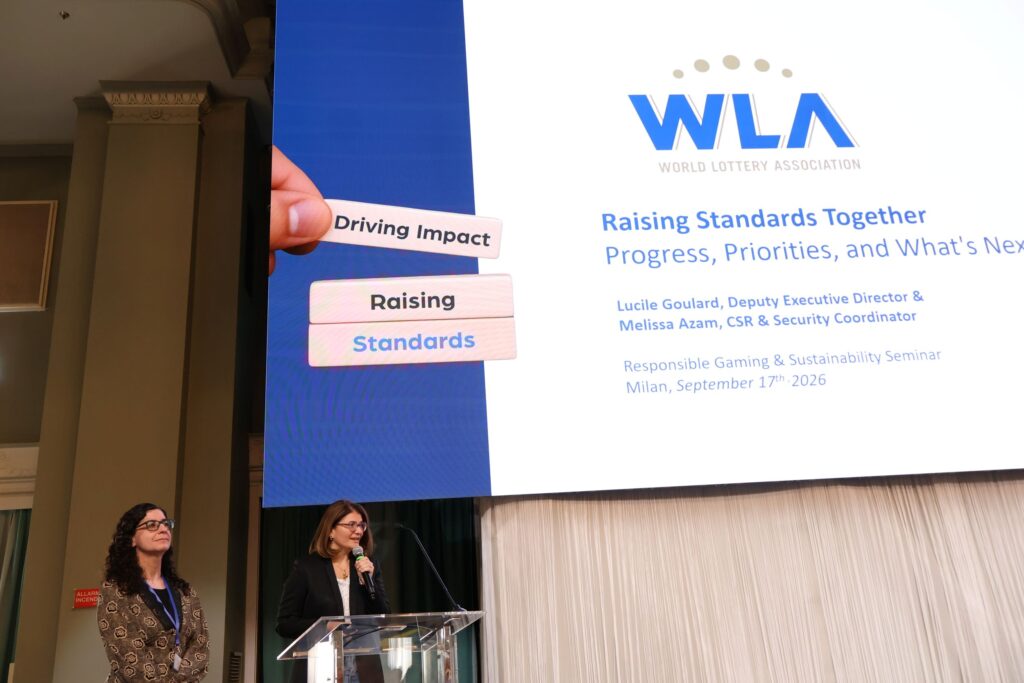

Over 170 participants from more than 40 countries gathered in Milan for the Responsible Gaming & Sustainability Seminar by European Lotteries and the World Lottery Association, hosted by Sisal. From new EL standards to artificial intelligence, and from mental health to ESG: responsibility is increasingly becoming the core of gaming business models.
It is no longer enough to declare oneself responsible. Today, the challenge is to prove that the tools implemented actually work. This was perhaps the clearest message to emerge in Milan from the Responsible Gaming & Sustainability Seminar 2026, organized jointly by The European Lotteries (EL) and the World Lottery Association (WLA) and hosted by Sisal from September 16 to 18.
An international event that brought together over 170 participants from more than 40 countries, seating operators, experts, researchers, and industry professionals at the same table. The title chosen for the seminar, Driving Impact, Raising Standards, clearly indicated the direction: shifting focus from statements of principle to the concrete results produced by responsible gaming and sustainability policies.
From compliance to effectiveness
The shift in perspective is significant. For years, a major part of the work on responsible gaming focused on building standards, procedures, and compliance tools. The debate in Milan instead showed a more mature phase: the question is not just which measures to adopt, but what effect they actually have on player behavior and protection.
The first day focused specifically on the evolution of standards. Arno Nagelschmied of Austrian Lotteries illustrated the path of the new EL Responsible Gaming Standards and Framework, characterized by a greater focus on outcomes, evidence, the effectiveness of adopted measures, and continuous improvement. Regarding sustainability, Stefania Colombo of Brightstar Italia and Susanna Saikkonen of Veikkaus addressed the evolution of the European ESG framework and the consequences for operators. Pauline Fieux of FDJ UNITED drew attention to dark patterns and the need to design customer experiences capable of reconciling commercial effectiveness with player protection.
This approach fits into a European sector with significant economic and social weight: according to EL data, in 2024, member lotteries generated 109.9 billion euros in sales and 46.1 billion in GGR, allocating a total of 29.4 billion euros to society through public budgets, social programs, sports, culture, health, and education.
The player returns to the center
One of the most interesting themes to emerge from the discussion was the effectiveness of responsible gaming communication itself.
Michael Wohl, Professor of Psychology at Carleton University, addressed the topic of Empathy Engineering: language, design, and protection tools can only work if they are built based on how they are actually perceived by the player. The goal is to make responsible gaming tools more relevant, usable, and non-stigmatizing, moving beyond merely prescriptive communication.
The seminar moved from theory to applications. Bjørn Helge Hoffmann of Norsk Tipping presented the experience of mandatory loss limits and their effects, with a particular focus on young adults. Vincent Perrotin of FDJ UNITED illustrated FDJ Protect, an internal model based on artificial intelligence used to identify potentially risky behaviors in online gaming. The system is integrated into a continuous monitoring and review process that includes external expertise and independent scientific evaluation.
Artificial intelligence thus enters the debate not only as a lever for product development but also as a potential protection technology. And AI, prediction markets, and unauthorized operators were identified by Sarah Taylor, Chair of the WLA CSR Committee, as the factors destined to have the greatest impact on the sector’s evolution.
Responsible gaming and mental health
The program further expanded its scope by addressing the relationship between gambling-related harm and mental health. Néstor Szerman, president of the World Association on Dual Disorders, brought the issue of the relationship between problematic behaviors and psychological vulnerability into the discussion, helping to place player protection in a broader dimension than just gaming product management.
This is an important cultural shift for the industry as well: it means considering prevention not as an isolated set of tools, but as a system in which technology, behavioral knowledge, communication, governance, and scientific research must engage in dialogue.
Sustainability beyond ESG
A similar change concerns sustainability. Paolo Taticchi, Professor of Strategy and Sustainability and Co-Director of the UCL Centre for Sustainable Business, brought to Milan a perspective that goes beyond identifying sustainability solely with regulatory compliance: sustainability as a potential factor for innovation, growth, and long-term value creation.
This is probably one of the most interesting points of contact between the two souls of the event. Responsible gaming and sustainability are progressively ceasing to be separate chapters of corporate responsibility and are tending to converge within the same question: what impact does a gaming company produce on the ecosystem in which it operates?
Milan and Sisal’s 80th anniversary
For Sisal, the seminar also took on a special meaning. The company celebrates its 80th anniversary in 2026, in the very city where it was born. In her opening speech, Rosangela Robbiani, Chief Public Affairs Officer of Flutter Southern Europe & Africa, symbolically linked three milestones: Sisal’s eighty years, the upcoming launch of Win for Italia Team with CONI, and her new role within Flutter SEA. Roots, positive impact, and the future, according to the summary proposed by the manager.
The historical reference proposed by the Secretary General of European Lotteries, Piet Van Baeveghem, also offered a significant interpretation. Starting from Giovanni Paolo Panini’s 1743 painting, ‘The Lottery in Piazza di Montecitorio,’ Van Baeveghem recalled how ancient the relationship between lotteries and society is. Tools, technologies, and markets have changed; however, the relationship between public gaming, transparency, trust, and contribution to the community remains central.
And it is perhaps here that the Milan seminar leaves its most relevant indication for the market. Raising standards does not just mean multiplying rules and procedures, but succeeding in measuring their effects.
The new frontier of responsible gaming therefore seems to be shifting from compliance to evidence, from intention to outcome. With data, research, technology, and independent evaluation called upon to prove that what is defined as “responsible” truly produces a positive impact on the player and on society.
A transformation that also directly concerns sustainability: no longer a side element of corporate reputation, but an increasingly structural component of strategy, governance, and, ultimately, the gaming industry’s very social license to operate.